
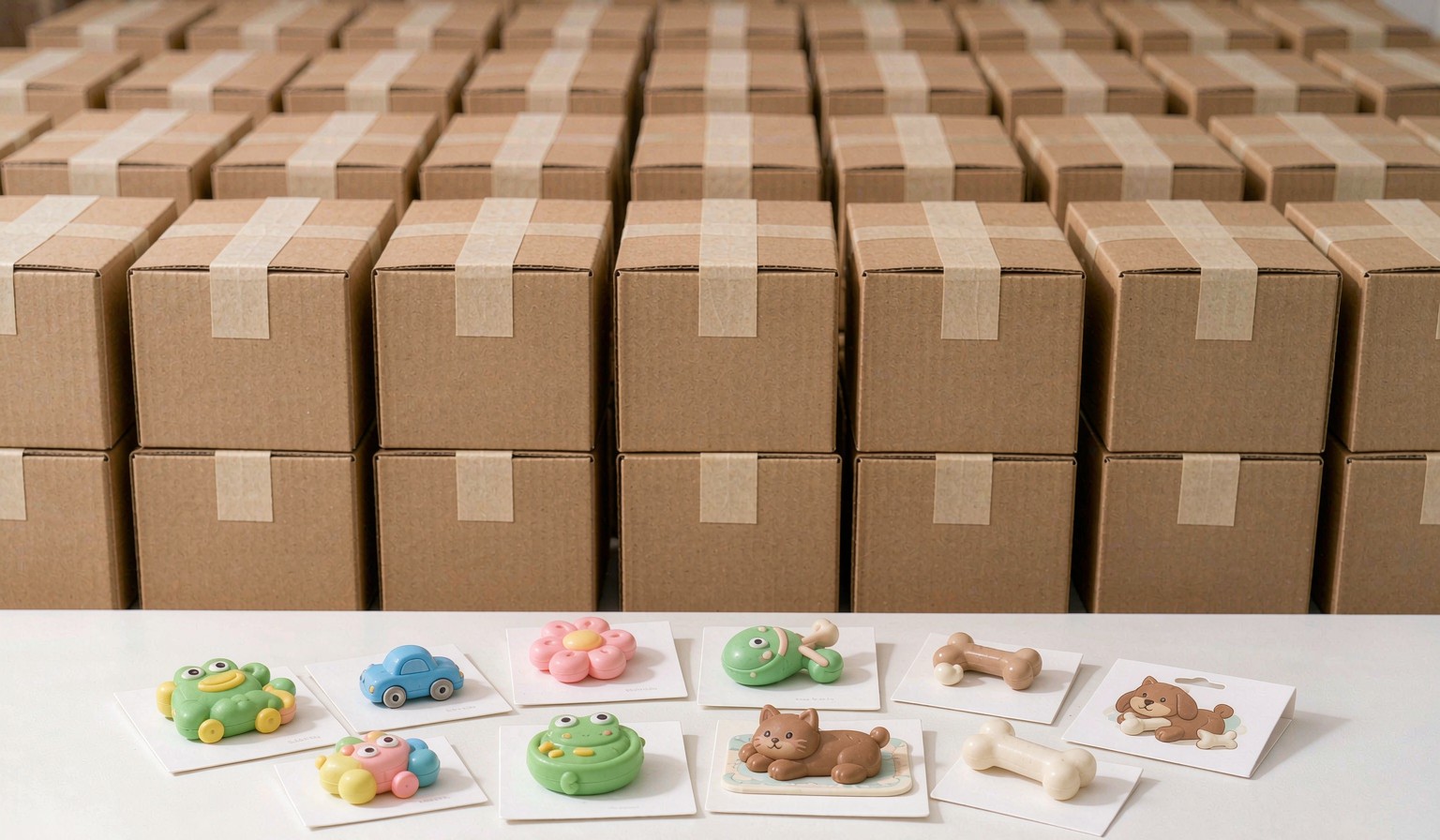
Sourcing pet products from a China manufacturer is the default for most Amazon and TikTok Shop sellers because the unit economics are hard to beat. The risk is not the country — it is the gap between the supplier's quoted lead time and the date inventory actually lands in your warehouse. This article lays out realistic MOQ ranges, a lead-time breakdown, a sampling checklist, and the safety-stock math you need before trusting a new factory with your Q4 volume.
Typical MOQ Ranges by Product Type
Minimum order quantities in China are driven by mold setup, fabric rolls, and production-run economics — not by the factory being difficult. Below are current typical MOQs for common pet categories.
| Product type | Typical MOQ | Notes |
|---|---|---|
| Catnip toys / plush | 500–1,000 pcs | Low tooling; color/style mixes allowed |
| Dog collars & leashes (nylon) | 300–500 pcs | Webbing rolls set the floor |
| Dog grooming brushes | 1,000–2,000 pcs | Injection mold amortization |
| Cat scratching posts | 200–500 pcs | Bulky; ocean freight dominates cost |
| Stainless pet bowls | 1,000–3,000 pcs | High mold cost, low unit price |
| Automatic feeders (electronics) | 500–1,000 pcs | Certifications (FCC/CE) add MOQ |
If a supplier quotes MOQ far below these, scrutinize: they may be reselling from a marketplace rather than manufacturing, which removes your ability to customize and control quality. For a curated starting point, review our cat toys and dog leashes & collars ranges.
Lead Time Breakdown
A quoted "25-day lead time" almost never means 25 days to your door. It means 25 days of production after artwork and deposit. The full pipeline looks like this:
| Stage | Typical days | Can compress? |
|---|---|---|
| Sampling & approval | 7–14 | Partly (pay express) |
| Deposit & material prep | 3–7 | No |
| Production run | 15–35 | Slightly |
| QC & packing | 2–4 | No |
| Ocean freight (China–US WC) | 18–28 | No (use air: 5–7) |
| Customs clearance | 2–5 | Partly |
| Last-mile to warehouse | 2–4 | Yes |
| Total ocean | 49–97 | — |
| Total air | 36–60 | — |
Plan against the ocean total plus a 10-day buffer. A realistic planning lead time for a new pet SKU is 70–100 days door-to-door on sea, 45–55 days on air. Many stockouts trace back to treating the factory quote as the real number. Build this into your master production calendar: if you want stock on US shelves by October 1, the purchase order must leave your desk no later than the first week of July, assuming no air expedite. Most late-Q4 stockouts are simply purchase orders placed in August, not supplier failures.
Sampling: What to Test and What It Costs
Never launch on a photo. A proper sampling sequence is:
- Proto sample (free–$30): confirms shape and basic material.
- Pre-production sample ($30–$80): uses final fabric/hardware; you sign off.
- Golden sample: the reference unit your QC checks production against.
- Production sample (post-run): pulled from the actual batch.
For pet items, test beyond cosmetics: tensile pull on dog leashes (aim >200 kg rating), chew resistance on toys, and material safety (phthalate-free, non-toxic dyes) since pets mouth everything. Budget $150–$400 total for a credible sampling cycle, plus express shipping. That spend prevents a $6,000 bad batch.
Incoterms: Who Pays for What
The quote you receive is meaningless without the Incoterm attached, because it defines where cost and risk transfer. EXW (ex-works) means you collect from the factory gate and own everything after — cheapest unit price, most logistics work, and you arrange export. FOB (free on board) means the supplier delivers to the port and clears export customs; you own from there and book the ocean freight. DDP (delivered duty paid) means the supplier lands it at your US door including duty — simplest, but you lose freight visibility and usually pay a premium baked into the unit price. For first-time pet sellers, FOB is the sweet spot: you control the freight forwarder (and thus lead-time visibility) while the factory handles export paperwork. Avoid DDP until you understand your true landed cost, because the supplier's "all-in" price hides margin you could capture by shipping yourself. A typical FOB quote of $6.50/unit can become an effective $7.80 under DDP once the factory adds freight, duty, and their risk premium.
Safety Stock Math for a New Supplier
With a new factory you face demand and lead-time uncertainty simultaneously. Safety stock protects against both. The standard formula:
Safety Stock = z × σ × √LT
Where z is the service-level factor (1.65 for 95%, 1.96 for 97.5%), σ is the standard deviation of daily demand, and LT is lead time in days.
Worked example — a cat toy selling 20 units/day, σ = 6 units/day, planning lead time 70 days, target 95% service (z = 1.65):
- √70 ≈ 8.37
- Safety Stock = 1.65 × 6 × 8.37 = 82.9 ≈ 83 units
Reorder point (units) = (daily demand × lead time) + safety stock = (20 × 70) + 83 = 1,483 units
So you must place the reorder when on-hand + in-transit drops to 1,483 units. Because a new supplier's σ is often underestimated, add a 20% judgment buffer on first three orders: plan to 1,780 units. For broader context on the catalog this supports, see our cat products overview.
Risk and Mitigation
| Risk | Likelihood | Mitigation |
|---|---|---|
| Supplier misses lead time | High (new) | Dual-source top SKUs; hold 1 extra batch |
| Quality drift mid-run | Medium | Golden-sample QC at 30% and 80% of run |
| MOQ too high for test | Medium | Negotiate 50% MOQ on first order |
| Customs hold (misdeclared HS) | Low–Med | Use experienced freight forwarder |
| IP / design leak | Medium | Split tooling; NDA + contract |
The single highest-leverage move is dual-sourcing your top 20% SKUs across two factories. It costs more in setup but turns a supplier delay from a catastrophe into a reroute.
FAQ
Q: What MOQ should I accept as a new seller?
A: Start at the category floor (300–500 for soft goods) and negotiate a 50% first order. If a factory refuses any flexibility on a first run, that is a signal they are not used to working with small Western brands.
Q: How long before Q4 should I place orders?
A: Place ocean orders by early July for an October arrival. That gives buffer for the 70–100 day pipeline plus peak-season port congestion. Air is your emergency lever, not your plan.
Q: Is sampling worth the cost for a $5 toy?
A: Yes. A $200 sampling cycle protects a $5,000–$10,000 production run. Skipping it is the most common cause of "the photos looked great but the product is junk" complaints.
Q: How much safety stock is enough for a brand-new SKU?
A: Use the z × σ × √LT formula at a 95% service level, then pad 20% on your first three reorders because your demand forecast is still weak. Recompute once you have 8–12 weeks of real sales data.
Sourcing right is half the battle; planning the inventory around it is the other half. Elieben works with pet sellers on both — contact us to review MOQ, lead time, and sampling for your next production run, and explore more on the Elieben blog.





