
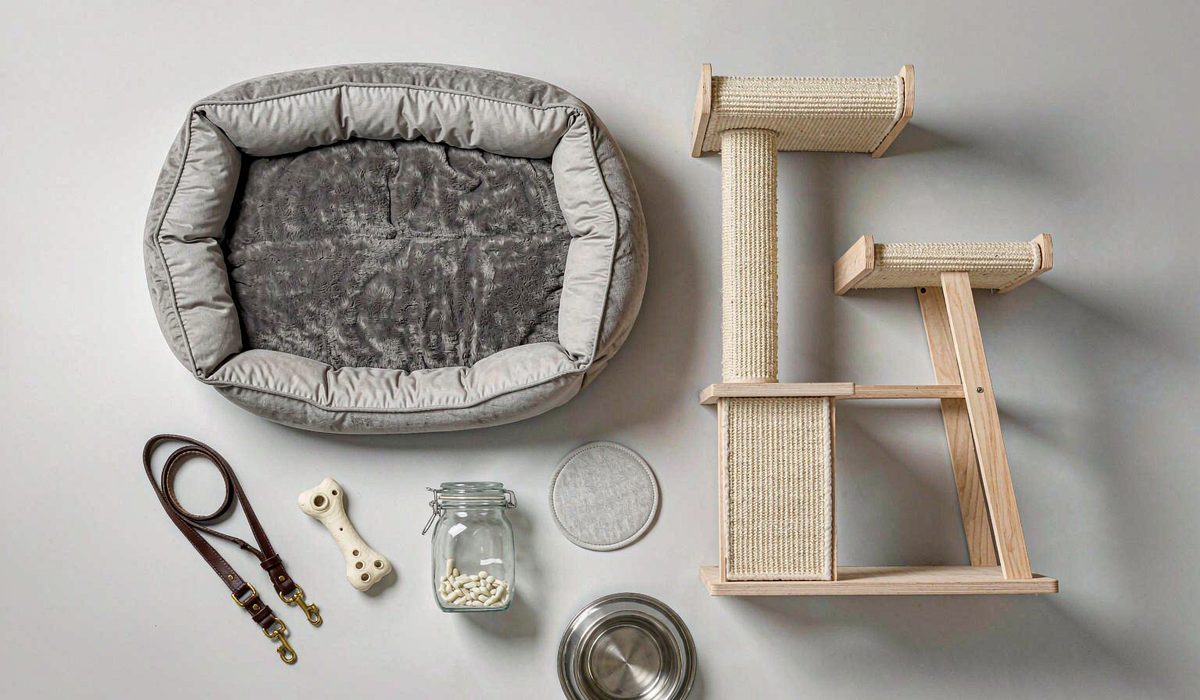
Choosing the right pet category is the single biggest lever on your Amazon margin. Most sellers obsess over PPC tweaks and listing copy, but the category you enter decides your ceiling before you spend a dollar on ads. We went through a 1,660-keyword pet research dataset — covering search demand, competition, and advertiser bid value — to rank the ten categories where private-label and differentiation still leave real room for profit in 2026.
How We Ranked Margin Potential (Methodology)
Margin is not one number. For a cross-border seller it is the gap between selling price and the sum of COGS, FBA fees, and customer acquisition cost. We used four signals from the keyword dataset as proxies:
- Demand — three-month search volume per keyword cluster.
- Competition — the tool’s competition rating (High / Medium / Low). Across the 1,660 keywords, 94% rated High, so “low competition” alone is rare; the real edge is differentiation.
- Advertiser value — top-of-page bid (页首高出价). A high bid means advertisers pay more per click, which usually signals higher customer lifetime value and healthier contribution margin.
- Momentum — keywords showing +900% month-over-month or year-over-year growth, which flag emerging, less-saturated pockets.
Read this as a map, not a guarantee. Every category below still rewards sellers who bring a defensible angle — a formula, a form factor, a brand, or a bundle — rather than a me-too commodity.
1. Fresh & Raw Dog Food (Delivery)
Demand: “fresh dog food delivery” and “raw dog food delivery” sit in the 1k–10k monthly range with the highest advertiser bids in the entire dataset (top-of-page bids up to ¥356). Why margin: subscription repeat purchases and premium price points. Caveat: food is the most regulated category — sourcing partners must hold the right facilities and documentation. Sourcing tip: work with an OEM that already produces human-grade recipes and can supply the compliance paper trail, then win on brand and bundling rather than price.
2. Natural & Organic Dog Food
“natural dog food” (top bid ¥151) and “all natural dog food” (¥125) show strong advertiser value without the cold-chain complexity of fresh food. Margin lever: limited-ingredient and single-protein positioning justifies a premium and is easy to differentiate on the listing. This is where a clear sourcing story — transparent ingredients, country of origin — converts into trust and repeat orders.
3. Flea, Tick & Parasite Control
Preventive treatments carry high advertiser bids (flea & tick treatments up to ¥61; prescription-adjacent items even higher) and near-perfect repurchase behavior. Trade-off: this is a compliance-heavy category (EPA / regional pesticide rules). Path: partner with a compliant manufacturer and lead with safety documentation and clear dosing — the trust barrier is the moat.
4. Cat Litter & Litter Systems
“cat litter” spiked +900% month-over-month in the dataset, with top bids around ¥35. Why it ranks: it is a consumable with a built-in repurchase loop and an easy upgrade path (odor-control, clumping, sifting boxes, enclosed furniture). Private-label litter with a scent or material angle (tofu, silica) sustains margin through subscription and bundle velocity.
5. Dog Beds (Orthopedic, Heated, “Fluffy”)
One of the largest demand surges in the data: “dog bed” jumped +900% MoM. Margin case: it is a home-goods product — simple to private label, easy to vary by size, fill, and cover — with higher perceived value than the COGS suggests. Orthopedic and heated variants command premium prices while sharing the same supply base.
6. Modern & Aesthetic Cat Trees
“modern cat tree” grew +900% year-over-year. Why margin: this is a décor-driven, Instagrammable niche where design — not specs — sets the price. Aesthetic cat trees and condos let a new brand charge a design premium with modest tooling changes, and the category is still fragmenting rather than locked up by incumbents.
7. Custom & Personalized Collars, Harnesses & Leashes
The collars/harness/leash cluster is the second-largest in the dataset (136 keywords), and “custom dog collars” / “dog collar with name” both surged +900%. Margin lever: personalization is the cleanest differentiation available — it moves the product from commodity to gift, supports higher AOV, and typically needs only low MOQ. This is a strong entry point for new private-label sellers.
8. Automatic & Smart Pet Feeders
“automatic pet feeder” rose +900% year-over-year. Why margin: smart-home pet gear carries a higher average order value and a tech-premium perception, while the core mechanism is a mature, cost-stable supply item. App-connected and portion-control models extend the price ladder.
9. Dog Grooming Tools
The grooming cluster (71 keywords) spans deshedding tools, silicone brushes, and bath kits. Margin case: tools sell once, but the category’s consumables — shampoos, wipes, nail care — drive repeat revenue. A grooming bundle (tool + consumable) lifts both AOV and lifetime value, and is straightforward to private label.
10. Cat Self-Grooming & Niche Enrichment
Pockets like “silvervine for cats” and “cat self-grooming” posted +900% YoY growth inside an otherwise high-competition map. Why margin: small, novel enrichment products face less direct comparison-shopping and support collector-style branding. These are ideal for testing demand with low MOQ before scaling.
Cross-Cutting Trend: The +900% Signal
Eighty keywords in the dataset showed triple-digit growth. The pattern is consistent — demand is rotating toward experience products (beds, aesthetic furniture, personalized gear, smart feeders) over plain commodities. For a new seller, that rotation is the opening: incumbents optimized for the old commodity search terms are slow to defend the new, design-led variants.
How to Validate a Category Before You Commit
Data ranks the opportunity; unit economics decide the outcome. Before locking a category:
- Model the stack: COGS + FBA fulfillment + expected CPC (use the dataset’s bid as a ceiling) + returns. If the gap is thin at realistic conversion, the category is a volume game, not a margin one.
- Confirm MOQ and tooling: low MOQ lets you test the +900% niches without betting the warehouse.
- Check compliance early: food, parasite control, and anything making a health claim each carry documentation requirements that vary by market.
- Order samples: photos and reviews are your real differentiator; verify quality before launch, not after.
How Elieben Supports Sellers
As a China-based B2B partner, we help Amazon, TikTok Shop, and DTC brands source, customize, and scale pet products across the categories above — from cat and dog toys to grooming tools and furniture. Our model centers on low MOQ, OEM customization, and the compliance documentation cross-border sellers need, so you can enter a high-value category without front-loading inventory risk.
Key Takeaways
- 94% of the 1,660 pet keywords rate High competition — differentiation, not niche-hunting, is the margin lever.
- Advertiser bid value clusters in food, parasite control, and fresh-delivery — high LTV, but higher compliance bars.
- The +900% growth pockets (beds, modern cat trees, custom collars, smart feeders) reward design-led private label.
- Validate with COGS + FBA + CPC math and low-MOQ sampling before committing.
Frequently Asked Questions
What is the highest-margin pet category on Amazon in 2026?
By advertiser value, fresh and raw dog food delivery lead the dataset, but they carry the heaviest compliance burden. For most new private-label sellers, design-led categories like modern cat trees, custom collars, and dog beds offer a better margin-to-complexity ratio.
Is pet food a good category for new Amazon sellers?
It has the highest customer value and repurchase rate, but food and parasite-control products require strict documentation and facilities. Enter with a compliant OEM partner and a clear brand angle rather than as a commodity importer.
How do I find low-competition pet niches?
Filter for triple-digit growth keywords (the dataset shows 80 at +900%) and look for design or personalization variants of commodity terms — e.g., “modern cat tree” or “custom dog collars” — where comparison-shopping is weaker.





